
How to Build Muscles according to science
In the fitness world, one question echoes louder than any other: “Why have I stopped progressing?”
Many individuals spend months, or even years, lifting weights without truly understanding how muscle tissue develops or why certain habits are actively sabotaging their hard work. Muscle hypertrophy is not a random occurrence. It is the precise byproduct of mechanical stimulus, structured nutrition, strategic recovery, and physiological adaptation.
To build a strong, symmetrical, and functional physique, you must understand what happens inside the muscle at an anatomical and cellular level.
What is Muscle Hypertrophy?
Muscle hypertrophy is the increase in the size of skeletal muscle fibers as an adaptive response to resistance training.
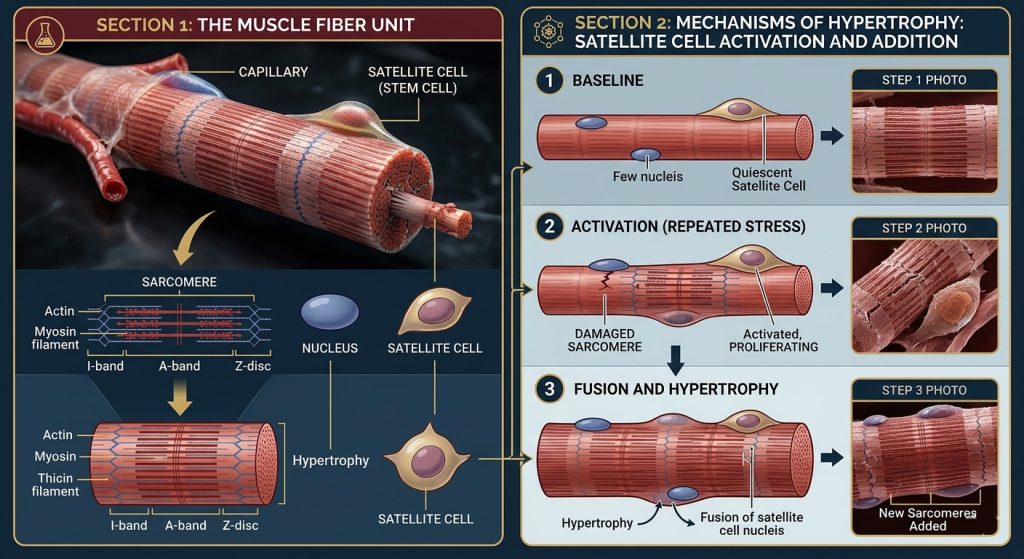
Structurally, skeletal muscle is a complex system composed of:
- Muscle fibers (cellular units)
- Myofibrils (cylindrical bundles within the fiber)
- Sarcomeres (the basic contractile units)
- Contractile proteins (specifically actin and myosin)
When you lift weights, your muscle fibers are subjected to intense mechanical stress, causing controlled micro-tears in the tissue. The body perceives this damage as a threat to its structural integrity and triggers an adaptive rebuilding process.
During the post-workout recovery phase, muscle protein synthesis (MPS) spikes. The fibers retain more contractile proteins, causing the muscle to become thicker, stronger, and more resilient.
Key Takeaway: Your muscles do not grow while you are lifting; they grow while you are resting.
The Anatomy of Muscle Growth: Three Drivers of Hypertrophy
Mechanical Tension
This is the primary driver of muscle growth. When a muscle is loaded with a sufficiently heavy weight through a full range of motion, the fibers experience high tension. This forces the central nervous system to recruit more motor units, specifically targeting Type II muscle fibers, which possess the highest potential for growth.
Mechanical tension triggers crucial anabolic pathways—most notably mTOR (mammalian target of rapamycin)—which acts as the master switch for protein synthesis.
Metabolic Stress
Commonly known as “the pump,” metabolic stress is caused by the accumulation of bioproducts during anaerobic exercise, including:
- Lactate
- Hydrogen ions
- Inorganic phosphate
This accumulation blood-gorges the working muscle, causes cell swelling, and stimulates the release of local anabolic hormones. This explains why both heavy, low-rep sets and moderate, high-rep sets can effectively drive hypertrophy.
Muscle Damage (Microtrauma)
Strenuous exercise induces microscopic tears in the sarcomeres, particularly during the eccentric phase (the lowering portion of a lift). The body responds to this microscopic trauma by activating satellite cells—specialized stem cells that rush to the damaged area, fuse to the muscle fibers, and help thicken the tissue. This process is also the main culprit behind Delayed Onset Muscle Soreness (DOMS).
Fueling the Machine: The Role of Nutrition
Without adequate raw materials, your body cannot construct new muscle tissue. To optimize hypertrophy, your diet must prioritize three foundational pillars:
| Macronutrient | Primary Role in Hypertrophy | Optimal Sources |
| Proteins | Provide essential amino acids to repair and rebuild torn muscle fibers. | Lean meats, eggs, fish, dairy, whey protein, and legumes. |
| Carbohydrates | The primary energy source for intense training; replenishes muscle glycogen stores. | Oats, rice, potatoes, whole grains, and fruits. |
| Healthy Fats | Crucial for hormone production (including testosterone) and absorbing fat-soluble vitamins. | Avocados, nuts, seeds, olive oil, and fatty fish. |
Five Common Mistakes Sabotaging Your Muscle Growth
Lack of Progressive Overload
Using the exact same weights, reps, and sets for months on end is the fastest way to plateau. Muscles only grow when forced to adapt to a new, increasingly challenging stimulus.
- The Fix: Regularly challenge your muscles by gradually increasing the weight, adding repetitions, increasing total volume, or improving execution and tempo.
Insufficient Recovery
Confounding sheer exhaustion with progress is a trap. An permanently fatigued muscle cannot generate maximum force, nor can it grow efficiently.
- The Fix: Prioritize 7–9 hours of quality sleep per night, schedule dedicated rest days, cycle your training splits to give muscle groups time off, and manage psychological stress.
Undereating or Imbalanced Nutrition
Even the most scientifically perfect workout routine will fail if your body lacks the necessary “building blocks.”
- The Fix: Consume adequate daily protein, stay well-hydrated, eat balanced meals, and avoid aggressive caloric deficits unless you are targeting a highly specific body recomposition phase.
Poor Exercise Execution (“Ego Lifting”)
Using momentum, swinging your body, or cutting the range of motion short drastically decreases target muscle activation while spiking your risk of injury.
- The Fix: Maintain strict control during the eccentric (lowering) phase, use a full range of motion, focus on the mind-muscle connection, and prioritize perfect technique over the number on the dumbbell.
Excessive Cardio
While cardiovascular health is essential, excessive high-intensity cardio can interfere with strength recovery and muscle retention, especially when paired with an aggressive caloric deficit.
- The Fix: Keep cardio moderate, separate intense cardio sessions from your heavy lifting days, and always keep resistance training as the primary focus of your programming.
The Danger of Overtraining
Overtraining occurs when your cumulative training volume and intensity consistently outpace your body’s ability to recover over a prolonged period. This is not simple tiredness; it is a complex physiological state that disrupts multiple systems.
Signs You Might Be Overtraining:
- Chronic fatigue and persistent joint pain
- A sudden drop in physical strength and lack of workout motivation
- Sleep disturbances and an elevated resting heart rate
- Stagnant muscle growth and heightened irritability
In severe cases, chronic overtraining leads to suppressed testosterone levels, elevated cortisol (the stress hormone), systemic inflammation, and a compromised immune system.
How to Prevent It:
- Periodization: Structure your training into blocks, alternating high-intensity phases with lighter “deload” weeks.
- Nutritional Sufficiency: Avoid prolonged, severe caloric deficits that starve your body of recovery resources.
- Listen to Your Body: Do not ignore persistent joint pain or mental burnout. Rest is a mandatory part of the discipline.
Building muscle mass is a scientific endeavor that requires discipline, consistency, and intelligent design. True progress in the gym does not come from chaotic, extreme, or performative workouts. It comes from mastering the delicate balance between maximum stimulation and optimal recovery.
Your muscles do not care how exhausted you are; they respond to how effectively you stimulate adaptation and how well you fuel your body to repair that adaptation. In fitness, intelligent consistency will always defeat reckless intensity.
Article by Sergiu Balaceanu


You May Also Like

The life of Miyamoto Musashi

The Babeș-Papanicolau Test
